
Well, here we are, one week further into my latest portrait commission as promised…. And voila, a beautiful smile for my girl!
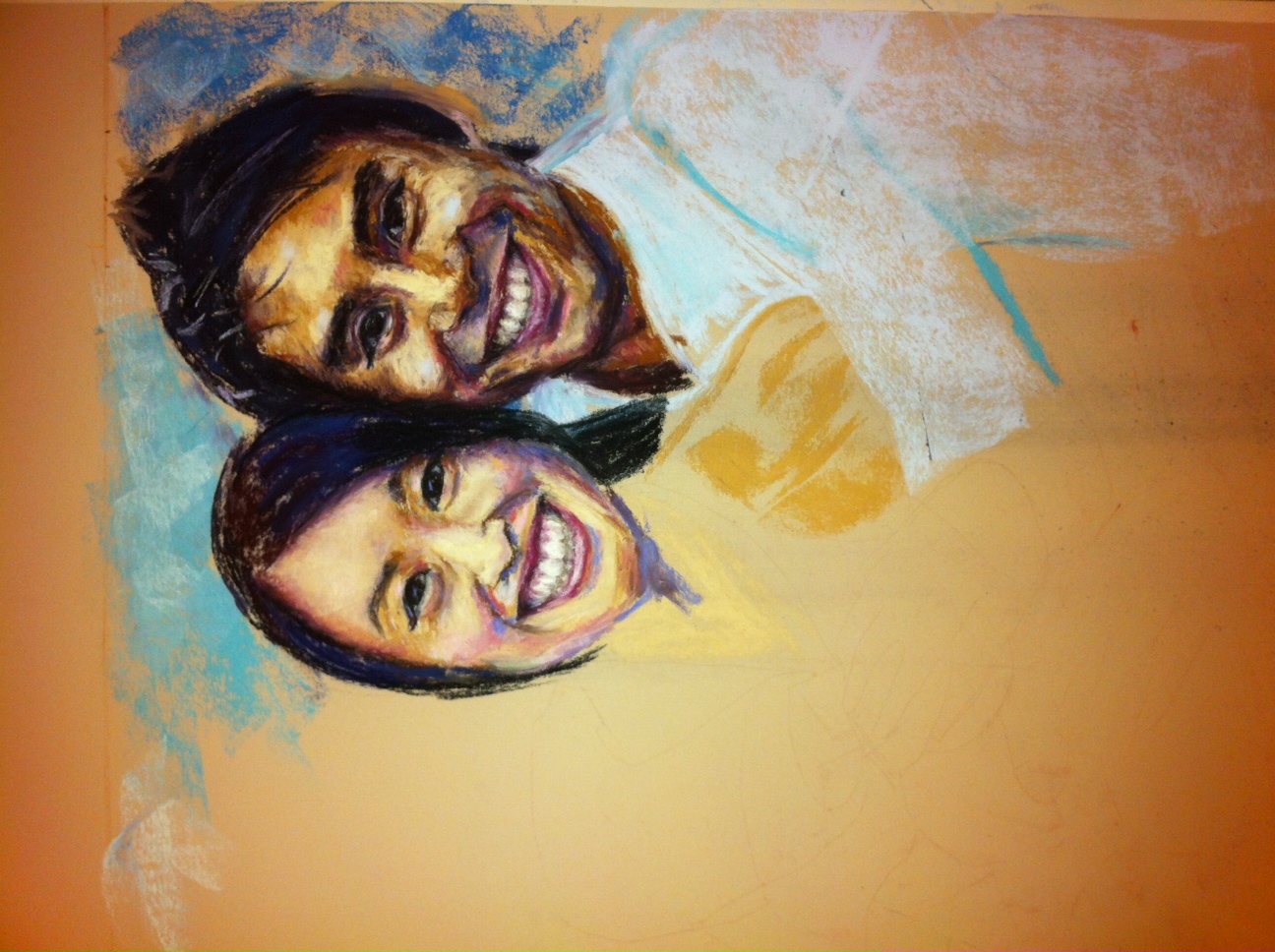
My girl's teeth done
Well, here we are, one week further into my latest portrait commission as promised…. And voila, a beautiful smile for my girl!
My girl's teeth done
My latest portrait commission is of this very happy and gorgeous couple.
It is moving along veeery slowly as I want to create a portrait that the couple and family will cherish. There are quite a few challenges here: a double portrait, heads at an angle, lots of teeth and hands everywhere. But of course I jump at an artistic challenge!
Anticipating these difficulties, I try to make things easier for myself by using the grid drawing method. I print out the photo, draw a grid over the print-out using 1 cm squares, then draw a grid with 3 cm squares on tracing paper. I then draw the image onto the tracing paper, using the grid as a guide. I rub pastel all over the back of the tracing paper, place the tracing paper on to my pastel paper and transfer the image by tracing over the image on the front of the tracing paper.
Hmmm… it sounds more complicated than it is.
So here you can see the sketch if you look very closely – it is quite faint – and I start to place the eyes and hair.

Sketch and placement of eyes
A few posts ago, I mentioned that I had joined Julia Kay’s Portrait Party on Flickr. It’s a virtual portrait party where portrait artists working in all styles and media come together to create images of each other. It is fascinating and inspiring to see the variety of work – and the quantity and speed with which it is produced. I am wondering if some of these artists draw in their sleep!
I have been pretty busy, myself. I have created another four on my iPad using the Artrage app, and two more with charcoal and white pastel on paper. It’s an easy way to study a huge variety of faces and a safe way to try out new ideas. And it’s crazy-fun. 🙂
Filed under Portrait Artists, Portrait Drawings, Portrait Paintings, Portraits
This isn’t so much a workshop as an information portal on colour. There have been millions of words written about colour theory, some fascinating and some bamboozling. I want to show you what I have found helpful so far in the hope that it will help you too.
A FEW FUNDAMENTALS:
When we talk about colour, we are talking about 3 things:
The HUE: this is the simple name we give to a colour – red, blue, green – but of course not all reds are equal.
The INTENSITY: this is the strength and vividness of a colour
And the VALUE: this is the lightness or darkness of a colour. For example, pink is a light version of red.
A TINT of a colour is a colour plus white; a SHADE of a colour is a colour plus black.
Getting the hang of these in a practical context is enormously helpful.
Filed under Portrait Paintings, Workshop
The never-ending quest for artistic improvement is a search for “eureka” moments. Those moments when the penny falls with such a clatter that your art jumps up several notches out of fright.
Here are a few of my past eureka moments:
In between these moments, I plod along, waiting for the next leap. I am busy searching for one now…
Filed under Portrait Artists, Portrait Paintings, Portraits
“Perfectionist” is not a word used to describe me. If I get the job done in a satisfactory and efficient manner, I am happy. Usually. Until now.
I want each painting I create to be better than the last. And if I don’t think it is, I am grumpy until I produce another, better one. It’s like I’m in an acrimonious competition with myself.
Here’s a question for you: is a painting good because the artist thinks it is good or because the audience thinks it is good? I like to think that any artwork that promotes an emotional reaction in the viewer has succeeded.
That’s my highbrow answer. My focus-group based, prime-ministerial, populist answer, is that I think my work is good if it gets a lot of Facebook Likes.
Validation is comforting.
Cut to me in the studio wrestling with my latest child portrait painting…
As I near the end of this painting I realise that I haven’t chosen the best reference picture – there’s too much shadow on the face. I battle with myself to improve it (“only a poor workman blames his tools”) and feel disheartened when I realise that I still haven’t bettered “Girl in Pink”. I publish it on Facebook with trepidation. Ruby’s mum says WOW! Yay!
But no Likes. None!* Painting fail?
Looking at it on my easel, I don’t think so. I think it’s quite lovely. But I still want to beat “Girl in Pink”, dammit!
Six years of a delectable bottle green in high school has led to my disaffection for green in most of its manifestations. The more observant of you will have noticed that there is not a whole lot of green in my art.
So, when I started creating this child portrait painting, with its original dominating yellows, I naturally reached for its complement, purple. The warm purple I chose for the background just wasn’t working, so I changed it to a cool purple. Then darker, then lighter but NO – the painting was not happy. It kept telling me I needed to use green.
Reluctantly, I picked out a virgin yellow-green from my set and instantly knew that was what the painting wanted.
I had discovered my first seriously bossy artwork.
Now we’re going to produce an expressive drawing using charcoal. I’ll share some of my charcoal portrait drawing tips – also bear in mind the proportions discussed earlier and how to hold your charcoal to keep loose.
You’ll need at least one stick of willow charcoal and an eraser. Get the thick charcoal sticks if you can. Some newsagents with an art section stock charcoal. I want you to use the eraser as a drawing tool rather than a correcting tool. If you make a mistake, just smudge it with your hand and draw over it. The build-up of charcoal adds to the mood of the piece.
Filed under Portrait Drawings, Portraits, Workshop
Drawing Facial Features
During my initial, tentative efforts to draw the face, I consulted books and copied drawings from the books. While the books helped with general anatomy and portrait drawing tips, the best way to learn for me was to make my own observations rather than copying someone else’s. This resulted in lots of self-portraits – most of them very bad and unworthy of posting on here. The point is: read these tips, check out the links, but create your OWN drawings. Make your own mistakes and discoveries.
My early self-portraits relied on line to define the shapes. I did some rudimentary shading but the focus was definitely on line. I wasn’t satisfied with them as I found them to be quite cartoonish, particularly the mouth. Once I changed my focus from line to looking at tone and varying degrees of light and shade, my drawings improved dramatically. I also think there is a difference between drawing accurately and drawing with emotion.
Filed under Portrait Paintings, Portraits, Workshop
What a wonderful day! Seven hours of drawing and creating surrounded by David White‘s very impressive portrait works. It is enough to inspire anyone.
Filed under Pastel Paintings and Drawings, Portrait Paintings, Portraits